
David Belkin – Bethesda, MD – 65 at the time of the event (February 18, 2007)
 I am a recent survivor of SCA (sudden cardiac arrest). Interestingly enough, I just came from my first visit with my electrophysiologist and when I referred to SCA, he looked puzzled. I said it referred to sudden cardiac arrest. He said he knew it as SCD or sudden cardiac death. I think his thinking is indicative of most people, including professionals, because most people do not survive my experience. I survived because there was an AED in place at the elementary school where I had my SCA.
It was the morning of February 18, 2007. I had been invited to play basketball by my son-in law in an elementary school gym in Honesdale Pennsylvania in the Poconos near my second home. I did not know any of the people playing except my son-law and a friend of his. It’s their standard Sunday morning game played with guys and one woman ranging in age from mid 30’s to 65. I had just turned 65 three days earlier. I was pronounced in perfect health by my primary care physician, having just had my physical on February 9th. I play tennis at least once a week and am on three softball teams so I am in pretty good shape for my age There were 11 of us. Our games were 4 on 4 played half court played to 15 with the winners continuing and the losers sitting. I played some; I sat some. We started about 9:30 and at about 11 am during one of the games I was playing in, I started to feel lightheaded and a little woozy. Thinking I was dehydrated and over exhausted, I started to walk towards the sidelines. I collapsed as I got to the sidelines into the stands hitting my head slightly and my left hip very hard (as indicated from the black and blue mark there). One of the guys came over to me immediately (he has since told me) and bending down, he saw that I was breathing very shallowly. This person happened to be an emergency room doctor and as he started to examine me, he said I started to turn blue. He pulled down my shorts to check my femoral artery and felt nothing. My heart had stopped.
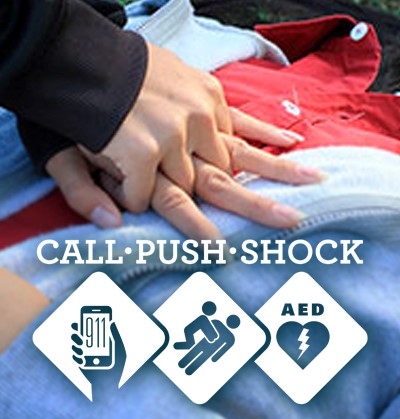
He immediately started CPR and another guy gave me mouth to mouth. Knowing that we were in Pennsylvania and that schools in Pennsylvania are required by law to have AEDs, he immediately shouted for one of the others to find the AED device. A fourth person called 9-1-1. The person looking for the AED found the janitor who immediately brought the AED to my side. He applied the AED to my chest (it only kicks in if it does not sense any electrical charge coming from the heart) and it immediately did what it was supposed to do. I think my heart started beating after one application. He says that I was out for less than three minutes.
About two minutes later, the EMT squad got there. I was weak and horribly nauseous and started to throw up. I also started to get up thinking I had merely fainted but they kept me down. The crew loaded me on a stretcher and took me to the hospital.
The guy who saved me said I was gone but for the AED. I am happy to report that because the AED was applied immediately I suffered no heart damage and the catheterization showed no blockages. I had an ICD implanted in me on February 21 and returned home to Maryland on February 24. Happily I will be able to resume my normal activities in a few weeks or so.
But for the AED being in that elementary school and being applied immediately, I know and have been told by my doctors that I would not be here today. Certainly, I would not have survived without any heart or brain damage. Had I had that damage, my care would have been an enormous use of the public’s healthcare dollars. I am on Medicare. Certainly the cost of a few AEDs more than offsets the savings in these healthcare costs that states and federal government would be otherwise required to pay out. Many more people, like myself, can be saved if these devices are placed in schools and other facilities used by the public. If we can spend money to have fire alarms in these very schools and public places to protect property, it seems that we can do the same thing to put these devices in the same places to save lives.
- David Belkin